
Market Insights·28 March 2025·2 min read·Alexander Guselnikov
Market Relief Bounce is Sold - week ending 28/03/2025
Markets kicked off the week with a burst of optimism, but by Friday, that bounce had fully reversed into a broad-based selloff.
Markets Performance
Markets kicked off the week with a burst of optimism, but by Friday, that bounce had fully reversed into a broad-based selloff. The rally corresponded to the seasonality cycle and coincided with deeply oversold conditions, with most depressed stocks like Tesla (TSLA) having the biggest bounce backs, all as we indicated in our prior newsletter.
SPY rallied sharply Monday (+1.8%) after former President Trump made unexpectedly measured comments about upcoming auto tariffs the week prior, hinting they could be applied “leniently” — a shift that eased trade war fears and sparked a powerful intraday reversal. That optimism carried over into Tuesday’s session, with the S&P 500 climbing further above its 200-day moving average, though under the surface, market breadth remained weak and cyclical leadership began to falter. Early-week gains were concentrated in mega cap tech, AI beneficiaries, and semiconductors, but sentiment quickly soured midweek as macro conditions reasserted themselves. Trump’s confirmation of a 25% tariff on all imported vehicles and parts, set to begin April 2, reignited inflationary concerns, just as incoming data revealed firmer-than-expected durable goods orders, rising personal income, and declining consumer confidence.
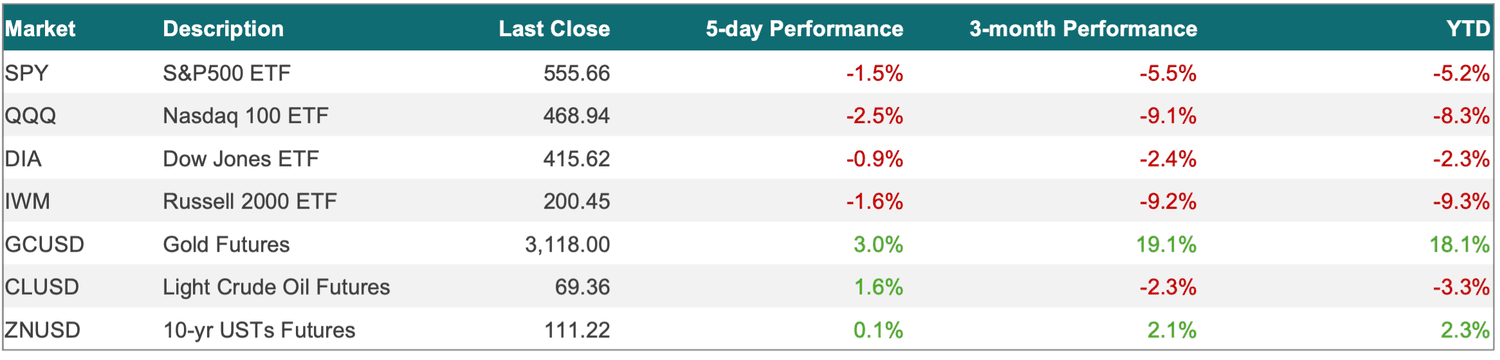
The week’s reversal intensified from Wednesday onward. Sticky inflation readings, hawkish Fed rhetoric, and a sharp drop in long-term inflation expectations led to renewed stagflation fears. The S&P 500 ETF (SPY) ended the week down -3.2%, breaking below its aforementioned 560 gamma put zone where selling intensified on Friday. Nasdaq 100 (QQQ) fell -4.4%, and small caps (IWM) dropped -4.0% — with all major indices now negative year-to-date. Technology (-3.7%) and Discretionary led the decline, while Staples (+1.7%) and Utilities outperformed as investors rotated defensively. Gold surged +3.0%, reflecting a clear hedge demand against policy inertia and tail risk. Credit markets began to flash caution as well: the ICE BofA U.S. High Yield Index OAS widened to 3.27% from 3.17% last week — a meaningful move, albeit at historically low levels not seen since pre-GFC, that reflects rising credit risk aversion even as equities stumble. Treasuries were flat, with 10Y futures (ZNUSD) edging up +0.1%, offering little offset to the equity volatility.
Taken together, this week marked a clear sentiment shift: not just a failed bounce, but a structural break lower, with both technical and macro factors driving renewed bearish momentum into quarter-end.
To read the full version of this week’s insights please click the “view in PDF” button at the top.
This investment thesis is prepared by Altai Capital for informational and analytical purposes. Investors should conduct independent due diligence and consult with financial advisors before making investment decisions. Past performance and historical precedents do not guarantee future results. Altai Capital’s portfolio may contain the mentioned security and thus this publication have vested interests.
This note is published for informational purposes only and is not investment advice or a recommendation to buy or sell any security. The author may hold positions in securities discussed. See the full disclaimer in the footer.
Keep reading
 Research Summit
11 October 2025 · 2 min read
$NTGR, Netgear Inc. - Likely Regulatory Tailwinds
Netgear represents a compelling opportunity to capitalize on potential U.S. regulatory action against Chinese router manufacturer TP-Link, which commands 65% of the U.S. market.
Read more Markets
7 September 2025 · 7 min read
Labour Markets Slowly Deteriorate as Inflation Buoys - week ending 07/09/2025
Equities digested a mixed macro tape but finished the week with a mild risk-on tone at the index level. SPY eked out +0.3%, while QQQ and IWM outperformed (+1.0% and +1.1%), with DIA slipping −0.2%.
Read more Markets
6 July 2025 · 8 min read
Markets at Extremes as we Enter Trade News Week - week ending 06/07/2025
U.S. equity markets extended their bullish streak through the shortened holiday week, with strong breadth and firm price action across all major indices.
Read more