
Market Insights·6 July 2025·8 min read·Alexander Guselnikov
Markets at Extremes as we Enter Trade News Week - week ending 06/07/2025
U.S. equity markets extended their bullish streak through the shortened holiday week, with strong breadth and firm price action across all major indices.
Markets Performance
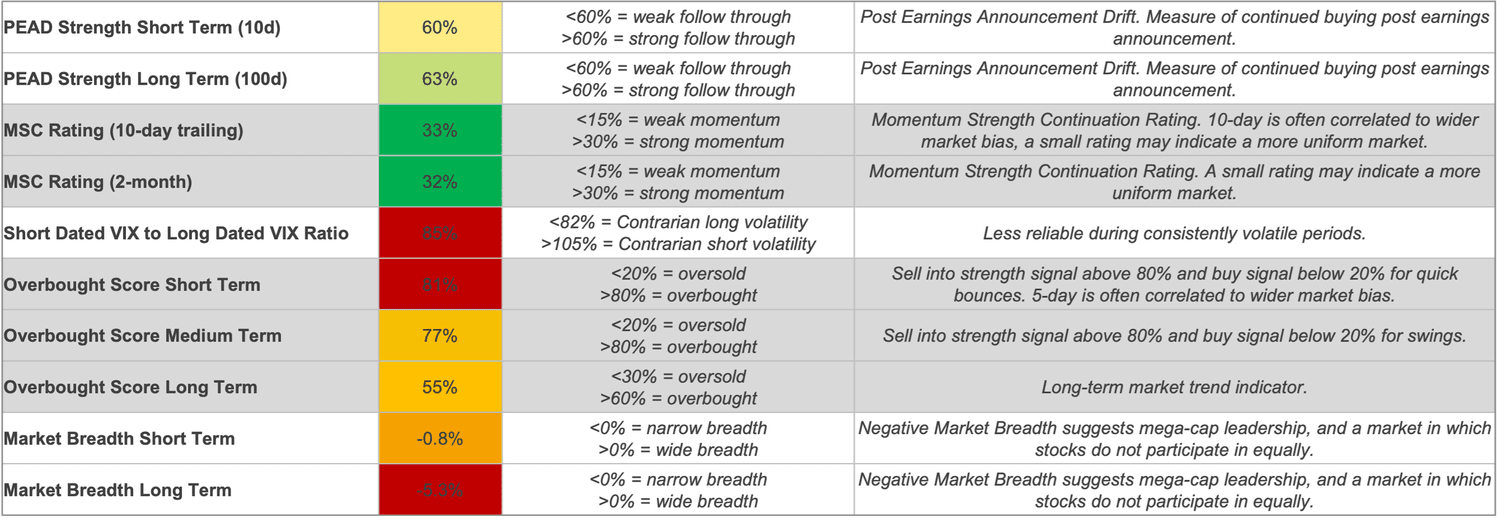
U.S. equity markets extended their bullish streak through the shortened holiday week, with strong breadth and firm price action across all major indices. The Russell 2000 (IWM) stood out with a +3.5% gain, outperforming as small caps caught a bid from improving economic sentiment and dovish rate expectations. The S&P 500 (SPY) advanced +1.7%, while the Nasdaq 100 (QQQ) added +1.5%, continuing to ride the wave of AI-driven enthusiasm and strong demand for growth assets. The Dow Jones (DIA) added +2.3%, boosted by industrials and financials, which benefitted from mild steepening in the Treasury curve. After two weeks of straight gains, the SPY closed the week 3.5x ADRs (Average Daily Range) above it’s 20-day moving average – a feat last seen on the 16th May 2025, 8th November 2024 and 16th July 2024, with the percentage of stocks above their 5-day moving average at an elevated 80.5% - tactical caution is warranted as we head into trade news and the next earnings season.

The rally was supported by a string of encouraging macro signals. Jobless claims declined, JOLTS data showed easing labour tightness, and the June nonfarm payrolls report delivered a Goldilocks print—headline strength but downward revisions and higher unemployment, consistent with a cooling but not collapsing labour market. On the inflation front, the ISM Services index delivered a sharp downside surprise, helping bolster the case for Fed easing. Gold (GCUSD) rose +1.8%, responding to steady real yields and ongoing demand for hedges against policy missteps. In contrast, 10-yr U.S. Treasury futures (ZNUSD) slipped -0.4%, as traders priced in better cyclical momentum and slight curve steepening.
Tuesday’s session offered a tactical shakeout, with a sharp momentum sell-off in extended names—particularly high-multiple tech—coinciding with a powerful breadth expansion into underloved parts of the tape. Industrials, financials, and healthcare all caught rotation flows, and while mega-cap growth lagged on the day, that repricing created room for sector rebalancing and hinted at growing conviction in a cyclical reacceleration thesis. Market internals notably improved, with up-volume and new highs spreading beyond just the usual AI complex. The sharp rotation out of crowded leaders into economically sensitive laggards suggests the bull market is broadening—a constructive development for Q3 risk sentiment.
Meanwhile, the U.S. trade narrative took center stage. The White House is promising a “flurry of trade deals” ahead of the July 9 deadline, according to senior officials, while Trump confirmed plans to issue reciprocal tariff letters to ~100 nations. These would enforce a 10–30% baseline tariff unless bilateral terms are renegotiated. The policy pivot toward “simplified universal tariffs” introduces headline risk into global sectors including autos, semis, and agri-exporters. Thus far, markets have taken the news in stride, but the sharp divergence between corporate supply chains and political urgency could become a volatility catalyst if diplomatic friction escalates.
Commodities reflected a modest pickup in geopolitical risk premium and demand-side optimism. Crude oil (CLUSD)rose +1.5%, aided by Middle East tensions, strong U.S. summer gasoline consumption, and preliminary signs of OPEC+ production discipline. The dollar drifted sideways, while implied equity volatility (VIX) stayed suppressed—hovering around the 12 handle—as positioning remained skewed toward bullish exposure and risk premia remained compressed.
Zooming out, the broader backdrop is characterized by firm nominal growth, easing inflation pressures, and a market growing more confident in the “soft landing” scenario. Flows continue to chase performance, with cyclicals, AI-adjacent tech, and industrials drawing capital. However, with SPY and QQQ sitting at all-time highs, tactical risks around next week’s CPI, Q2 earnings season, and Trump’s July 9 tariff deadline are coming into focus. While participation broadened late in the week, leadership remains narrowly concentrated, reinforcing the importance of tactical rotation and macro-aware positioning as we enter the heart of summer trading.
Core Equity Market Readings
Macro Data This Week
Key Data - Tuesday 1st July 2025
JOLTS job openings (May) fell to 7.769 million from a revised 7.395 million, slightly above the 7.3 million consensus, but still near three-year lows. The trend continues to reflect a gradual cooling in labor demand as hiring plans moderate.
The ISM Manufacturing PMI (June) rebounded to 49.0, beating expectations of 48.8 and improving from 48.5 in May. Employment and new orders components also showed modest gains, signaling a slow stabilization in the goods-producing side of the economy.
Bond yields rose modestly (10Y +4bps) on the manufacturing beat, while equities saw intraday rotation into cyclicals. Investors viewed the data as consistent with a reacceleration in industrial activity, but still soft enough to keep the Fed on a path toward cuts.
Key Data - Wednesday 2nd July 2025
The ADP Employment Report (June) surprised sharply to the downside with a 33K job loss, missing expectations for a +95K gain. This marked the worst private payroll reading since early 2020 and suggests private sector hiring momentum has weakened notably.
Meanwhile, EIA petroleum data showed an unexpected 3.8M barrel build in crude inventories and a 4.2M build in gasoline stocks, raising concerns over summer demand softness despite geopolitical tensions.
Markets reacted by rotating further into rate-sensitive assets. Treasuries rallied, the 2Y yield dropped ~5bps, and equity bulls took the soft labor signal as validation of near-term easing. The data reinforced a shift in tone: from hot labor markets to fragile growth beneath the surface.
Key Data - Thursday 3rd July 2025
June nonfarm payrolls came in at 147K, below the 110K consensus but modestly above the revised 144K in May. The unemployment rate ticked up to 4.1%, while average hourly earnings rose +0.2% MoM and +3.7% YoY, both slightly softer than expected.
The Initial Jobless Claims print was 233K, beating expectations of 240K, while the participation rate rose to 62.3%, suggesting labor supply is gradually improving. The overall takeaway was mixed: while the headline jobs number was solid, wage growth and unemployment trends point toward building labor slack.
Equities recovered from early losses as the report was seen as dovish enough to keep September rate cuts firmly on the table, especially with soft ADP data in the rearview.
Themes in Play
Embraer (ERJ) – New Highs, Buy on Dips, Beware of Parabolic Run Ups
Embraer (ERJ) has surged over 30% since April, hitting new multi-year highs as investor excitement builds around its $20B defense backlog, regional jet orders, and growing traction in commercial aviation. Key catalysts include increased deliveries of the E2 series, firm export demand, and positive readthroughs from NATO-aligned countries boosting defense procurement.
The company now trades at an $11.3B capitalization, ~16x forward EBITDA, well above its 5-year median of ~11x, suggesting a meaningful rerating has already occurred. Sell-side sentiment remains bullish, but positioning looks crowded, and short-term momentum signals are extended. Technicals point to overbought conditions at current prices.
While ERJ’s fundamentals remain intact, the parabolic move raises risk of a near-term blow-off top. Investors should consider using controlled pullbacks as entry points rather than chasing price. Tactical support sits near $52-55, where volume shelf and trend converge. If macro tailwinds (defense orders, Brazil fiscal reform) hold, ERJ remains a compelling rotation play within global aero-defense.
Big Bear AI (BBAI) - An AI Play on US Border Security
BigBear.ai (BBAI) has become a momentum standout in the small-cap AI-defense crossover space, rallying sharply on the back of political tailwinds, border security contracts, and retail-driven enthusiasm. The catalyst was a renewed focus on immigration surveillance tech as U.S. agencies upgrade AI infrastructure along the southern border.
The company recently secured a $141M U.S. Army contract and is actively involved in DARPA-backed LLM applications for battlefield decision support. Its public-private positioning aligns it with rising government demand for explainable AI and real-time situational awareness. However, commercial revenues remain minimal, and execution risk is elevated.
Valuation has ballooned to ~11x trailing sales following two weeks of straight gains on record volumes, while short interest hovers near 15% of float, suggesting a squeeze-prone but fragile setup. For traders, BBAI is a tactical long driven by headlines and momentum. For fundamental allocators, it remains speculative.
US to Announce Reciprocal Tariffs** **
The U.S. trade landscape is heating up. Former President Donald Trump confirmed that his campaign will send out reciprocal tariff letters to approximately 100 countries this week, proposing 10–30% flat tariff rates unless countries match U.S. treatment of American goods. The shift from bilateral negotiation to universal enforcement is a stark break from traditional trade diplomacy.
Among the likely targets are India (26%), Japan (24%), and the European Union (20%), which currently impose significantly higher average tariffs on U.S. goods. The proposed regime could inject headline volatility into globally exposed sectors like autos (TSLA, F), semis (NVDA, AMD), and industrial exporters (DE, CAT, HON).
In contrast, the White House is simultaneously accelerating trade talks, promising a “flurry of agreements” ahead of the July 9 deadline. Markets have so far been complacent, but any escalation into retaliatory tariffs or WTO friction could reignite FX and risk volatility. For now, global multinationals face binary outcomes—and markets are not pricing in tail risk.
BBB Delays Cuts to Renewable Incentives – Who Benefits?
The Big, Beautiful Bill (BBB) passed by Congress last week includes a major reprieve for the renewable energy sector. The phase-out timeline for wind and solar tax credits has been extended through 2027, with a 12-month safe harbor for projects already in motion. This ensures pipeline certainty and reduces near-term funding risk.
Crucially, the controversial 50% excise tax on non-compliant wind projects was stripped from the final text, eliminating a major policy overhang for developers. This benefits large utility-scale operators and sponsors whose project timelines were jeopardized by shifting compliance thresholds.
Key beneficiaries include NextEra Energy (NEE), Enphase Energy (ENPH), and First Solar (FSLR)—all of which have deep backlogs and high operating leverage to tax credits. The extension of the Section 45Z Clean Fuel Production Credit through 2029 also boosts renewable natural gas (RNG) and sustainable aviation fuel (SAF) producers such as GEVO and CVX biofuels unit. The bill reasserts clean energy as a strategic pillar, with new investment likely to follow.
This investment thesis is prepared by Altai Capital for informational and analytical purposes. Investors should conduct independent due diligence and consult with financial advisors before making investment decisions. Past performance and historical precedents do not guarantee future results. Altai Capital’s portfolio may contain the mentioned security and thus this publication have vested interests.
This note is published for informational purposes only and is not investment advice or a recommendation to buy or sell any security. The author may hold positions in securities discussed. See the full disclaimer in the footer.
Keep reading
 Research Summit
11 October 2025 · 2 min read
$NTGR, Netgear Inc. - Likely Regulatory Tailwinds
Netgear represents a compelling opportunity to capitalize on potential U.S. regulatory action against Chinese router manufacturer TP-Link, which commands 65% of the U.S. market.
Read more Markets
7 September 2025 · 7 min read
Labour Markets Slowly Deteriorate as Inflation Buoys - week ending 07/09/2025
Equities digested a mixed macro tape but finished the week with a mild risk-on tone at the index level. SPY eked out +0.3%, while QQQ and IWM outperformed (+1.0% and +1.1%), with DIA slipping −0.2%.
Read more Markets
29 June 2025 · 2 min read
Markets Hit All Time Highs, Again - week ending 29/06/2025
Equity markets posted strong, broad-based gains this week, in spite of hotter-than-expected macroeconomic prints and dovish signals from Federal Reserve officials.
Read more